Code
library(ggplot2)
library(data.table)
library(patchwork)

base_dir <- here::here()
source(file.path(base_dir, "sim-analyze.R"))

mcols <- method_colors()
mlabs <- method_labels()
dlabs <- dgp_short_labels()Registration Benchmark v2
library(ggplot2)
library(data.table)
library(patchwork)
base_dir <- here::here()
source(file.path(base_dir, "sim-analyze.R"))
mcols <- method_colors()
mlabs <- method_labels()
dlabs <- dgp_short_labels()dt <- load_study_b()study_b_keys <- c("method", "dgp", "noise_sd", "severity")
best <- aggregate_metric(
dt = dt,
metric = "warp_mise",
by = c(study_b_keys, "lambda"),
stat = "median",
value_name = "mise"
)
baseline <- best[lambda == 0, .(method, dgp, noise_sd, severity, base = mise)]
optimal <- find_optimal_by_metric(
dt = dt,
metric = "warp_mise",
by = study_b_keys,
option_col = "lambda",
stat = "median",
value_name = "mise"
)
warp_ratio_all <- ratio_to_baseline(
dt = dt,
metric = "warp_mise",
by = c(study_b_keys, "lambda"),
baseline_col = "lambda",
baseline_level = 0,
stat = "median",
value_name = "mise",
baseline_name = "base_mise",
ratio_name = "ratio",
keep_baseline = TRUE
)
merged <- merge(
optimal,
warp_ratio_all[, .(method, dgp, noise_sd, severity, lambda, base_mise, ratio)],
by = c("method", "dgp", "noise_sd", "severity", "lambda")
)
ae_best <- aggregate_metric(
dt = dt,
metric = "alignment_error",
by = c(study_b_keys, "lambda"),
stat = "median",
value_name = "ae"
)
ae_baseline <- ae_best[lambda == 0, .(method, dgp, noise_sd, severity, base = ae)]
ae_optimal <- find_optimal_by_metric(
dt = dt,
metric = "alignment_error",
by = study_b_keys,
option_col = "lambda",
stat = "median",
value_name = "ae"
)
ae_ratio_all <- ratio_to_baseline(
dt = dt,
metric = "alignment_error",
by = c(study_b_keys, "lambda"),
baseline_col = "lambda",
baseline_level = 0,
stat = "median",
value_name = "ae",
baseline_name = "base_ae",
ratio_name = "ratio",
keep_baseline = TRUE
)
ae_merged <- merge(
ae_optimal,
ae_ratio_all[, .(method, dgp, noise_sd, severity, lambda, base_ae, ratio)],
by = c("method", "dgp", "noise_sd", "severity", "lambda")
)
lambda_comp <- compare_optima(
opt_a = optimal,
opt_b = ae_optimal,
key_cols = study_b_keys,
value_cols = c("lambda", "lambda"),
value_names = c("mise_lambda", "ae_lambda")
)Study B tests whether regularization (lambda > 0) can rescue registration methods in regimes where they struggle. Design: 4 DGPs \(\times\) 8 lambdas \(\times\) 3 methods (SRVF, CC default, CC crit1) \(\times\) 3 noise \(\times\) 2 severity \(\times\) 33 reps = 19,008 runs.
Lambda grid calibrated by pilot (job 5131464): c(0, 1e-4, 1e-3, 0.01, 0.05, 0.1, 1, 10).
cat(sprintf("- Rows: %d | Failures: %d (%.1f%%)\n",
nrow(dt), sum(dt$failure), 100 * mean(dt$failure)))cat(sprintf("- DGPs: %s\n", paste(levels(dt$dgp), collapse = ", ")))cat(sprintf("- Methods: %s\n", paste(levels(dt$method), collapse = ", ")))cat(sprintf("- Lambdas: %s\n", paste(sort(unique(dt$lambda)), collapse = ", ")))cat(sprintf("- Noise: %s\n", paste(levels(dt$noise_sd), collapse = ", ")))Conditional-on-success MISE comparisons can be biased if failure rates vary by lambda. The table below checks this.
fail_by_lambda <- dt[,
  .(n_total = .N,
    n_fail = sum(failure),
    rate_pct = sprintf("%.1f", 100 * mean(failure))),
  by = .(method, lambda)
]
fail_wide <- dcast(fail_by_lambda,
  method ~ lambda,
  value.var = "rate_pct")
knitr::kable(fail_wide,
caption = "Failure rate (%) by method and lambda, pooling across DGPs, noise, severity, and reps.")| method | 0 | 1e-04 | 0.001 | 0.01 | 0.05 | 0.1 | 1 | 10 |
|---|---|---|---|---|---|---|---|---|
| srvf | 0.0 | 0.0 | 0.0 | 0.0 | 0.0 | 0.0 | 0.0 | 0.0 |
| cc_default | 0.0 | 0.0 | 0.0 | 0.0 | 0.0 | 0.0 | 0.0 | 0.0 |
| cc_crit1 | 0.0 | 0.0 | 0.0 | 0.0 | 0.0 | 0.0 | 0.0 | 0.0 |
The core question: does the MISE-vs-lambda curve show a U-shape (optimal lambda > 0)?
agg <- dt[failure == FALSE,
  .(mise = median(warp_mise, na.rm = TRUE),
    q25 = quantile(warp_mise, 0.25, na.rm = TRUE),
    q75 = quantile(warp_mise, 0.75, na.rm = TRUE)),
  by = .(method, dgp, noise_sd, severity, lambda)
]

# Baseline (lambda = 0) for reference lines
baseline <- agg[lambda == 0, .(method, dgp, noise_sd, severity, base = mise)]

ggplot(agg[severity == "1"],
  aes(x = lambda + 1e-5, y = mise, color = method)) +
  geom_line(linewidth = 0.6) +
  geom_point(size = 1.5) +
  geom_errorbar(aes(ymin = q25, ymax = q75), width = 0.15, alpha = 0.4) +
  geom_hline(data = baseline[severity == "1"],
    aes(yintercept = base, color = method),
    linetype = "dashed", alpha = 0.5) +
  facet_grid(dgp ~ noise_sd,
    scales = "free_y",
    labeller = labeller(
      noise_sd = function(x) paste0("noise = ", x),
      dgp = dlabs)) +
  scale_x_log10(
    breaks = c(1e-5, 1e-4, 1e-3, 0.01, 0.05, 0.1, 1, 10),
    labels = c("0", "1e-4", "1e-3", "0.01", "0.05", "0.1", "1", "10")) +
  scale_color_manual(values = mcols, labels = mlabs) +
  scale_y_log10() +
  labs(x = expression(lambda ~ "(log scale)"),
    y = "Warp MISE (median, log scale)",
    color = "Method") +
  theme_benchmark() +
  theme(legend.position = "bottom")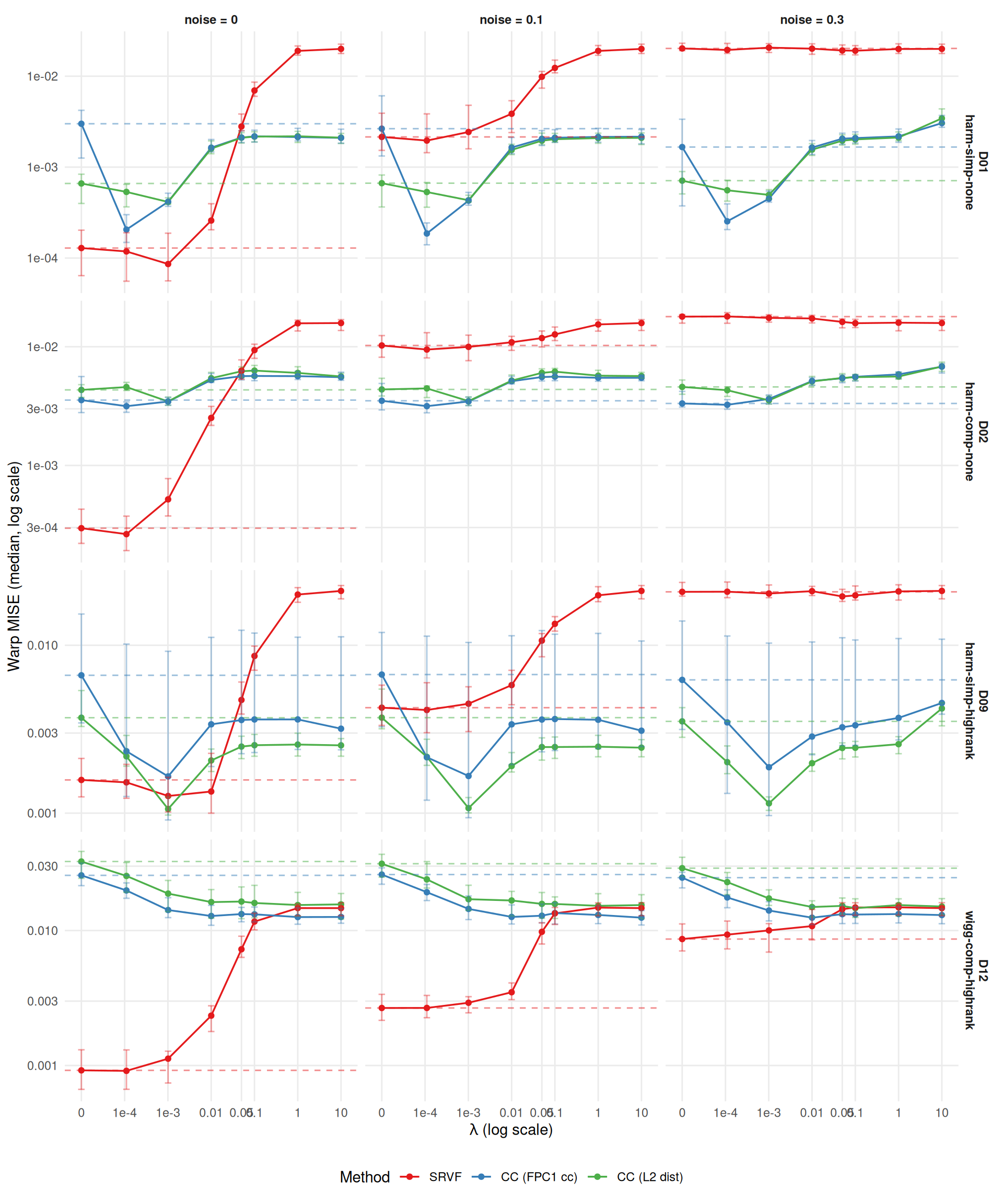
ggplot(agg[severity == "0.5"],
  aes(x = lambda + 1e-5, y = mise, color = method)) +
  geom_line(linewidth = 0.6) +
  geom_point(size = 1.5) +
  geom_errorbar(aes(ymin = q25, ymax = q75), width = 0.15, alpha = 0.4) +
  geom_hline(data = baseline[severity == "0.5"],
    aes(yintercept = base, color = method),
    linetype = "dashed", alpha = 0.5) +
  facet_grid(dgp ~ noise_sd,
    scales = "free_y",
    labeller = labeller(
      noise_sd = function(x) paste0("noise = ", x),
      dgp = dlabs)) +
  scale_x_log10(
    breaks = c(1e-5, 1e-4, 1e-3, 0.01, 0.05, 0.1, 1, 10),
    labels = c("0", "1e-4", "1e-3", "0.01", "0.05", "0.1", "1", "10")) +
  scale_color_manual(values = mcols, labels = mlabs) +
  scale_y_log10() +
  labs(x = expression(lambda ~ "(log scale)"),
    y = "Warp MISE (median, log scale)",
    color = "Method") +
  theme_benchmark() +
  theme(legend.position = "bottom")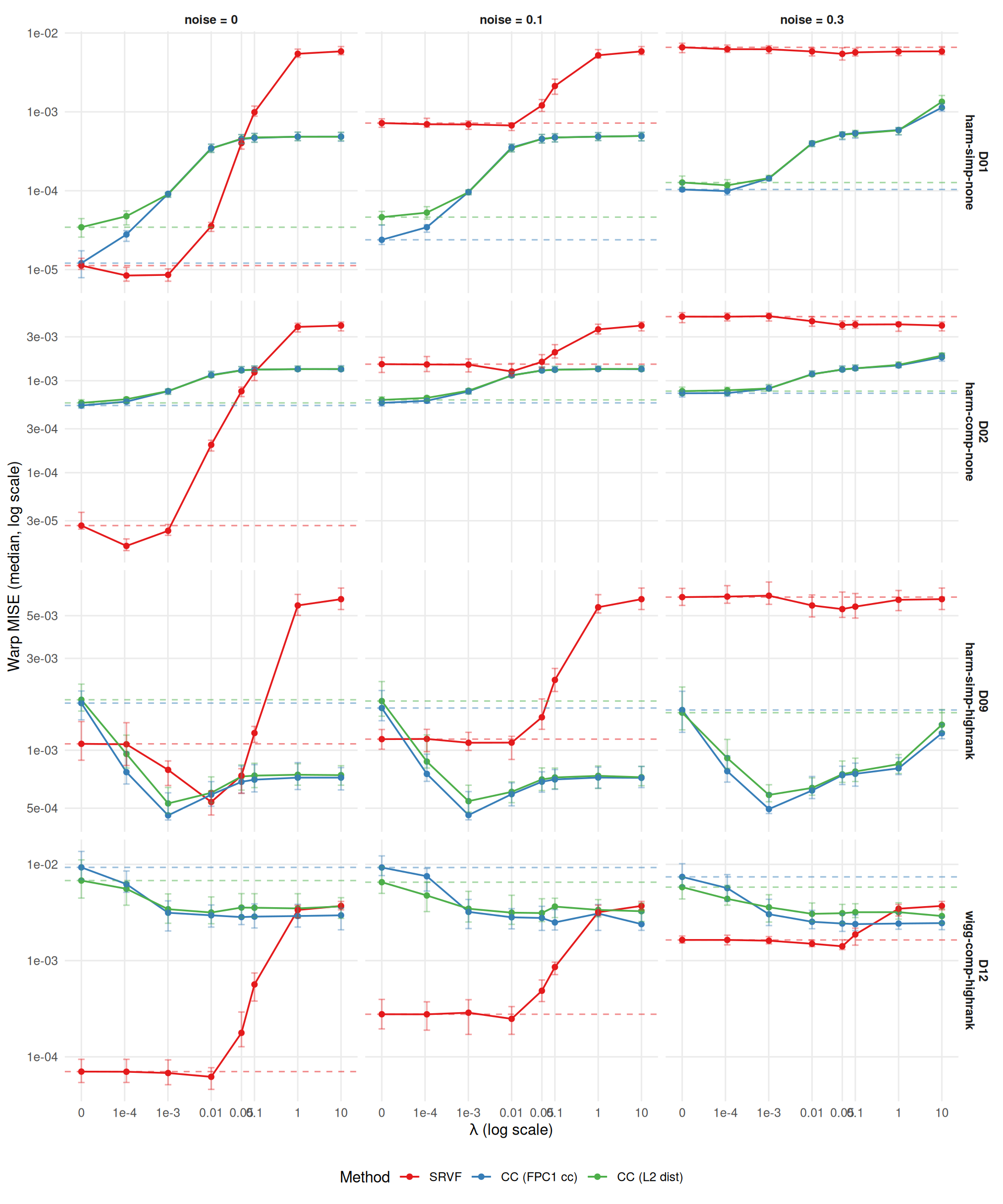
cat("## Optimal lambda per method x DGP x condition\n\n")opt_wide <- dcast(
optimal[, .(method, dgp, severity, noise_sd, lambda)],
method + dgp + severity ~ noise_sd,
value.var = "lambda"
)
knitr::kable(opt_wide, caption = "Optimal lambda by method, DGP, and severity. Columns show noise levels.")| method | dgp | severity | 0 | 0.1 | 0.3 |
|---|---|---|---|---|---|
| srvf | D01 | 0.5 | 0.000 | 1e-02 | 5e-02 |
| srvf | D01 | 1 | 0.001 | 0e+00 | 1e-01 |
| srvf | D02 | 0.5 | 0.000 | 1e-02 | 1e+01 |
| srvf | D02 | 1 | 0.000 | 0e+00 | 1e-01 |
| srvf | D09 | 0.5 | 0.010 | 1e-03 | 5e-02 |
| srvf | D09 | 1 | 0.001 | 0e+00 | 5e-02 |
| srvf | D12 | 0.5 | 0.010 | 1e-02 | 5e-02 |
| srvf | D12 | 1 | 0.000 | 0e+00 | 0e+00 |
| cc_default | D01 | 0.5 | 0.000 | 0e+00 | 0e+00 |
| cc_default | D01 | 1 | 0.000 | 0e+00 | 0e+00 |
| cc_default | D02 | 0.5 | 0.000 | 0e+00 | 0e+00 |
| cc_default | D02 | 1 | 0.000 | 0e+00 | 0e+00 |
| cc_default | D09 | 0.5 | 0.001 | 1e-03 | 1e-03 |
| cc_default | D09 | 1 | 0.001 | 1e-03 | 1e-03 |
| cc_default | D12 | 0.5 | 0.050 | 1e+01 | 1e-01 |
| cc_default | D12 | 1 | 1.000 | 1e+01 | 1e-02 |
| cc_crit1 | D01 | 0.5 | 0.000 | 0e+00 | 0e+00 |
| cc_crit1 | D01 | 1 | 0.001 | 1e-03 | 1e-03 |
| cc_crit1 | D02 | 0.5 | 0.000 | 0e+00 | 0e+00 |
| cc_crit1 | D02 | 1 | 0.001 | 1e-03 | 1e-03 |
| cc_crit1 | D09 | 0.5 | 0.001 | 1e-03 | 1e-03 |
| cc_crit1 | D09 | 1 | 0.001 | 1e-03 | 1e-03 |
| cc_crit1 | D12 | 0.5 | 0.010 | 5e-02 | 1e+01 |
| cc_crit1 | D12 | 1 | 1.000 | 1e+00 | 1e-01 |
# Check if optimal lambda shifts with noise
cat("\n## Does optimal lambda shift with noise?\n\n")for (m in levels(dt$method)) {
sub <- optimal[method == m]
# Most common optimal lambda per noise level (mode, not median — grid is discrete)
by_noise <- sub[, .(
mode_lambda = {
tab <- table(lambda)
as.numeric(names(tab)[which.max(tab)])
},
n_zero = sum(lambda == 0),
n_total = .N
), by = noise_sd]
cat(sprintf("- **%s**: most common optimal λ by noise: %s. ",
mlabs[m],
paste(sprintf("noise=%s → %g (%d/%d at λ=0)",
by_noise$noise_sd, by_noise$mode_lambda,
by_noise$n_zero, by_noise$n_total), collapse = "; ")))
# Full frequency table across all conditions
freq <- sub[, .N, by = lambda][order(lambda)]
freq_txt <- paste(sprintf("%g: %d", freq$lambda, freq$N), collapse = ", ")
cat(sprintf("Distribution: {%s}. ", freq_txt))
# Flag boundary hits
n_boundary <- sum(sub$lambda == max(sub$lambda))
if (n_boundary > 0) {
cat(sprintf("**%d/%d cells hit boundary (λ=%g).**",
n_boundary, nrow(sub), max(sub$lambda)))
}
cat("\n")
}How much does the best lambda improve over lambda=0?
Note: This is an oracle analysis — the optimal lambda is selected ex post from the same data used to evaluate it. Ratios \(\leq 1\) by construction (the baseline lambda=0 is always in the candidate set). The practical benefit of penalization depends on whether a good lambda can be selected a priori or via cross-validation.
min_ratio <- min(merged$ratio, na.rm = TRUE)

ggplot(merged,
  aes(x = interaction(noise_sd, severity, sep = " / sev="),
    y = interaction(dgp, method, sep = " : "),
    fill = ratio)) +
  geom_tile(color = "white") +
  geom_text(aes(label = sprintf("%.2f\n(λ=%g)", ratio, lambda)),
    size = 2.5) +
  scale_fill_gradient(
    low = "#2ca02c", high = "white",
    limits = c(min_ratio, 1),
    oob = scales::squish
  ) +
  labs(x = "noise / severity",
    y = "DGP : Method",
    fill = "MISE ratio\n(vs λ=0)") +
  theme_benchmark() +
  theme(axis.text.x = element_text(angle = 45, hjust = 1))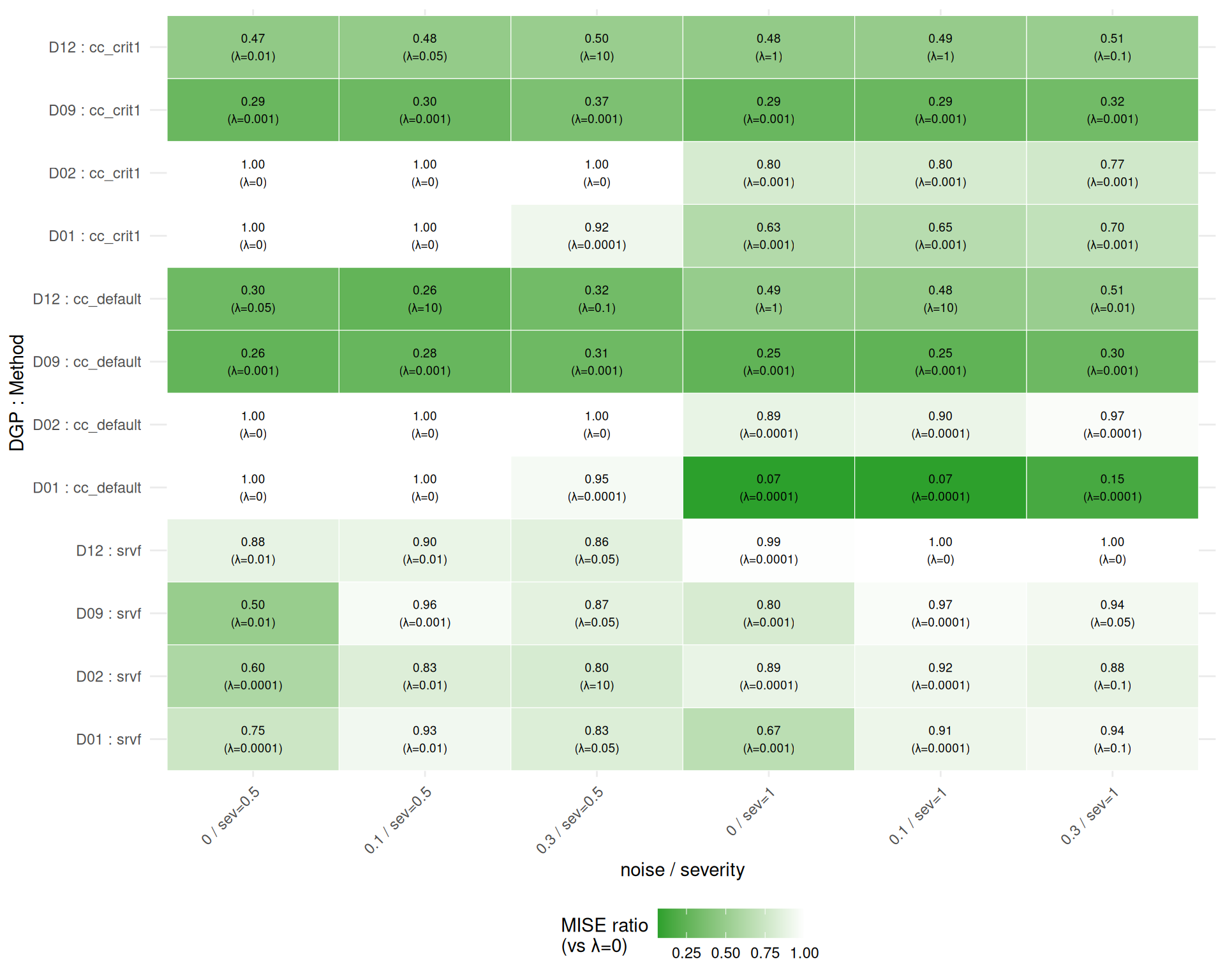
cat("**Findings:**\n\n")Findings:
ratio_by_method <- mean_se_table(merged, "ratio", "method")[order(mean)]
cat("Average improvement ratio across the 24 method-specific cells ",
  "(mean ± SE; lower is better):\n\n")
Average improvement ratio across the 24 method-specific cells (mean ± SE; lower is better):
for (i in seq_len(nrow(ratio_by_method))) {
  r <- ratio_by_method[i]
  cat(sprintf("- **%s**: %s (n=%d)\n",
    mlabs[r$method], fmt_mean_se(r$mean, r$se), r$n))
}cat("\n")# Biggest winners
big_win <- merged[ratio < 0.8][order(ratio)]
if (nrow(big_win) > 0) {
cat("Cases where penalization improves MISE by >20%:\n\n")
for (i in seq_len(min(nrow(big_win), 10))) {
r <- big_win[i]
cat(sprintf("- %s on %s (noise=%s, sev=%s): %.0f%% improvement at λ=%g\n",
mlabs[r$method], r$dgp, r$noise_sd, r$severity,
100 * (1 - r$ratio), r$lambda))
}
}Cases where penalization improves MISE by >20%:
cat("\n")Does cc_crit1 respond differently to lambda than cc_default?
# Check whether severity=0.5 patterns differ qualitatively
fda_both <- dt[failure == FALSE & method %in% c("cc_default", "cc_crit1")]
fda_agg_both <- fda_both[,
  .(mise = median(warp_mise, na.rm = TRUE)),
  by = .(method, dgp, noise_sd, severity, lambda)
]
# Correlation of MISE profiles across severity
cor_default <- cor(
  fda_agg_both[method == "cc_default" & severity == "0.5", mise],
  fda_agg_both[method == "cc_default" & severity == "1", mise],
  use = "complete.obs"
)
cor_crit1 <- cor(
  fda_agg_both[method == "cc_crit1" & severity == "0.5", mise],
  fda_agg_both[method == "cc_crit1" & severity == "1", mise],
  use = "complete.obs"
)
cat(sprintf(
  "Results shown for severity=1.0. MISE profiles are highly correlated across severities (r=%.2f for cc_default, r=%.2f for cc_crit1); severity=0.5 patterns are qualitatively similar.\n\n",
  cor_default, cor_crit1))
Results shown for severity=1.0. MISE profiles are highly correlated across severities (r=0.95 for cc_default, r=0.99 for cc_crit1); severity=0.5 patterns are qualitatively similar.
fda_dt <- dt[failure == FALSE & method %in% c("cc_default", "cc_crit1")]
fda_agg <- aggregate_median_iqr(
  dt = fda_dt[severity == "1"],
  metric = "warp_mise",
  by = c("method", "dgp", "noise_sd", "lambda"),
  value_name = "mise"
)

ggplot(fda_agg,
  aes(x = lambda + 1e-5, y = mise, color = method)) +
  geom_line(linewidth = 0.8) +
  geom_point(size = 2) +
  geom_errorbar(aes(ymin = q25, ymax = q75), width = 0.15, alpha = 0.35) +
  facet_grid(dgp ~ noise_sd,
    scales = "free_y",
    labeller = labeller(
      noise_sd = function(x) paste0("noise = ", x),
      dgp = dlabs)) +
  scale_x_log10(
    breaks = c(1e-5, 1e-4, 1e-3, 0.01, 0.05, 0.1, 1, 10),
    labels = c("0", "1e-4", "1e-3", "0.01", "0.05", "0.1", "1", "10")) +
  scale_color_manual(values = mcols, labels = mlabs) +
  scale_y_log10() +
  labs(x = expression(lambda ~ "(log scale)"),
    y = "Warp MISE (median, log scale)",
    color = "Method") +
  theme_benchmark() +
  theme(legend.position = "bottom")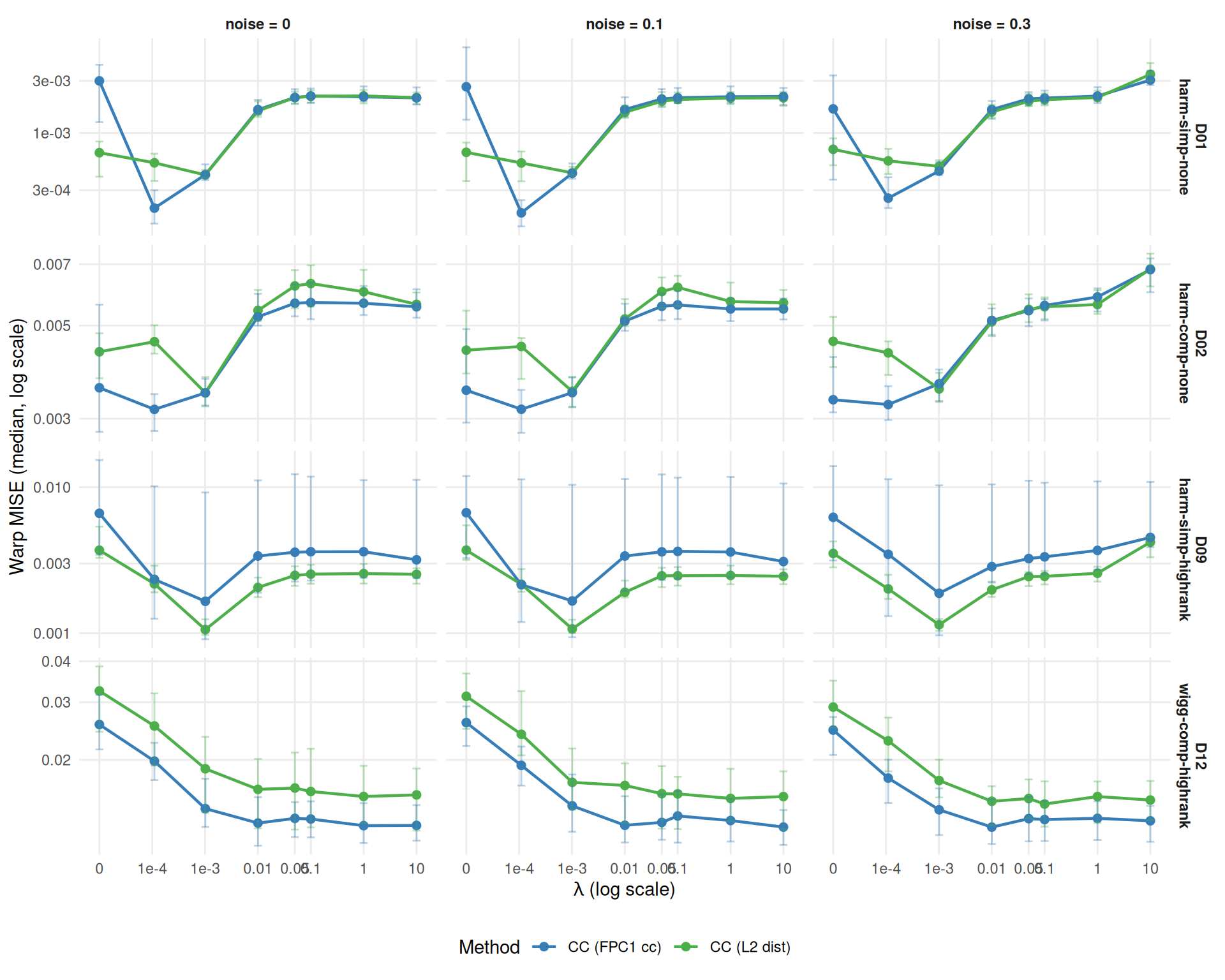
# Compare optimal lambdas for the two CC methods
fda_opt <- optimal[method %in% c("cc_default", "cc_crit1")]
fda_comp <- dcast(
  fda_opt[, .(method, dgp, noise_sd, severity, lambda, mise)],
  dgp + noise_sd + severity ~ method,
  value.var = list("lambda", "mise")
)

cat("**CC criterion comparison:**\n\n")
CC criterion comparison:
# Paired comparison: how often is crit1's optimal lambda higher/lower/equal?
fda_comp[, crit1_higher := lambda_cc_crit1 > lambda_cc_default]
fda_comp[, crit1_lower := lambda_cc_crit1 < lambda_cc_default]
fda_comp[, crit1_equal := lambda_cc_crit1 == lambda_cc_default]
n_higher <- sum(fda_comp$crit1_higher, na.rm = TRUE)
n_lower <- sum(fda_comp$crit1_lower, na.rm = TRUE)
n_equal <- sum(fda_comp$crit1_equal, na.rm = TRUE)
n_comp <- nrow(fda_comp)
cat(sprintf(
  "- Paired comparison of optimal λ: cc_crit1 higher in %d/%d, lower in %d/%d, equal in %d/%d cells.\n",
n_higher, n_comp, n_lower, n_comp, n_equal, n_comp))# Which criterion wins at its own optimal lambda?
fda_comp[, crit1_wins := mise_cc_crit1 < mise_cc_default]
cat(sprintf("- At each method's optimal lambda, cc_crit1 wins in %d/%d conditions.\n",
sum(fda_comp$crit1_wins, na.rm = TRUE), nrow(fda_comp)))fda_comp[, mise_gap := mise_cc_crit1 - mise_cc_default]
gap_summary <- mean_se_table(fda_comp, "mise_gap", character())[1]
cat(sprintf(
"- At each method's own optimum, the average MISE difference (crit1 - default) is %s.\n",
fmt_mean_se(gap_summary$mean, gap_summary$se, digits = 3)
))cat("\n")SRVF’s lambda response is expected to differ qualitatively from CC methods.
srvf_both <- dt[failure == FALSE & method == "srvf"]
srvf_agg_both <- srvf_both[,
  .(mise = median(warp_mise, na.rm = TRUE)),
  by = .(dgp, noise_sd, severity, lambda)
]
cor_srvf <- cor(
  srvf_agg_both[severity == "0.5", mise],
  srvf_agg_both[severity == "1", mise],
  use = "complete.obs"
)
cat(sprintf(
  "Results shown for severity=1.0. SRVF MISE profiles across severities are highly correlated (r=%.2f); severity=0.5 patterns are qualitatively similar.\n\n",
  cor_srvf))
Results shown for severity=1.0. SRVF MISE profiles across severities are highly correlated (r=0.94); severity=0.5 patterns are qualitatively similar.
srvf_agg <- dt[failure == FALSE & method == "srvf" & severity == "1",
  .(mise = median(warp_mise, na.rm = TRUE),
    q25 = quantile(warp_mise, 0.25, na.rm = TRUE),
    q75 = quantile(warp_mise, 0.75, na.rm = TRUE)),
  by = .(dgp, noise_sd, lambda)
]

ggplot(srvf_agg,
  aes(x = lambda + 1e-5, y = mise, color = noise_sd)) +
  geom_line(linewidth = 0.8) +
  geom_point(size = 2) +
  geom_ribbon(aes(ymin = q25, ymax = q75, fill = noise_sd),
    alpha = 0.15, color = NA) +
  facet_wrap(~dgp, scales = "free_y", labeller = as_labeller(dlabs)) +
  scale_x_log10(
    breaks = c(1e-5, 1e-4, 1e-3, 0.01, 0.05, 0.1, 1, 10),
    labels = c("0", "1e-4", "1e-3", "0.01", "0.05", "0.1", "1", "10")) +
  scale_color_brewer(palette = "Set1") +
  scale_fill_brewer(palette = "Set1") +
  scale_y_log10() +
  labs(x = expression(lambda ~ "(log scale)"),
    y = "Warp MISE (median ± IQR, log scale)",
    color = "Noise", fill = "Noise") +
  theme_benchmark() +
  theme(legend.position = "bottom")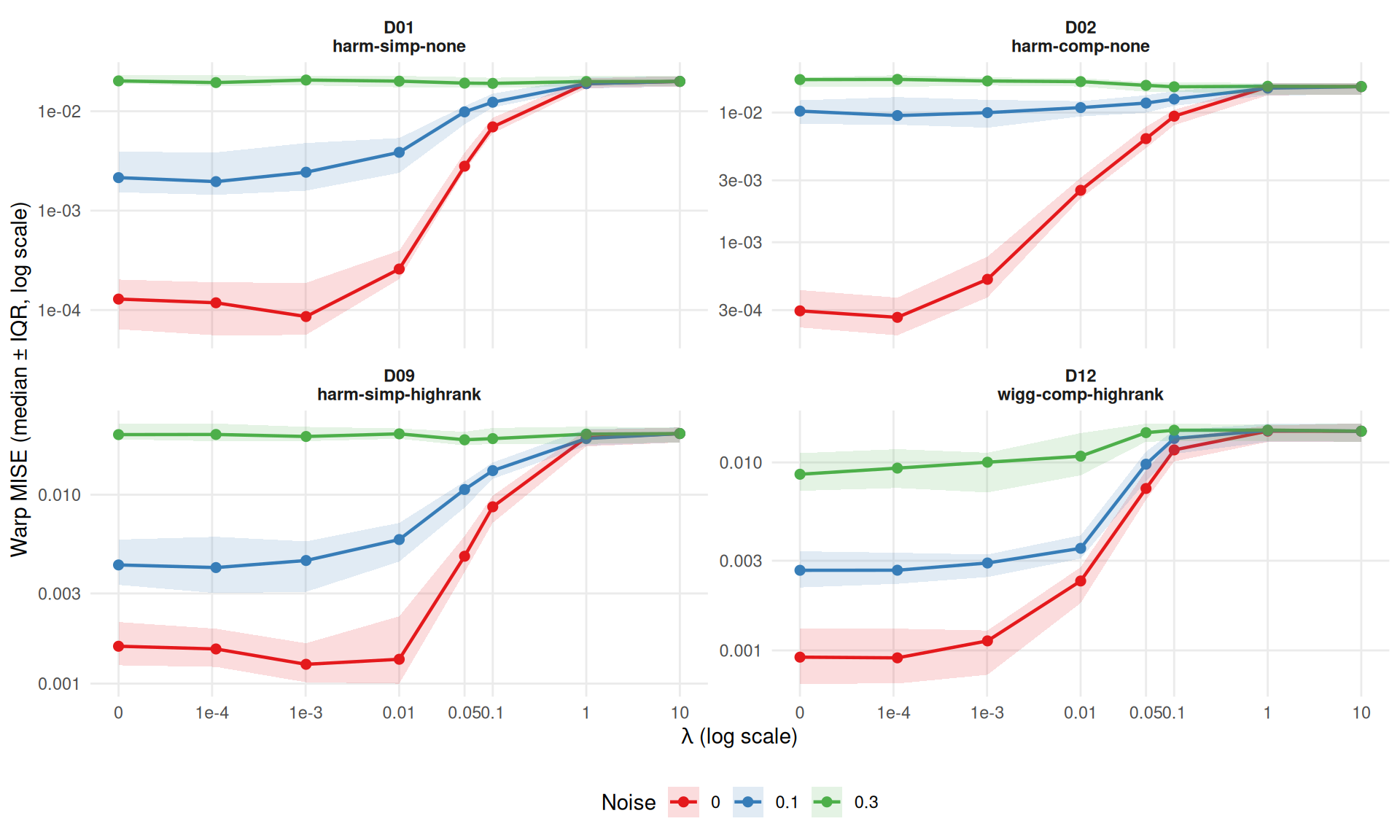
srvf_opt <- optimal[method == "srvf"]
cat("**SRVF lambda findings:**\n\n")
SRVF lambda findings:
for (d in levels(dt$dgp)) {
  sub <- srvf_opt[dgp == d]
  lambdas <- sub[, .(noise_sd, lambda, mise)]
  cat(sprintf("- **%s** (%s): optimal λ = %s\n",
    d, dlabs[d],
    paste(sprintf("%g (noise=%s)", lambdas$lambda, lambdas$noise_sd),
      collapse = ", ")))
}cat("\n")# Does lambda ever help SRVF substantially?
srvf_merged <- merged[method == "srvf"]
helps <- srvf_merged[ratio < 0.9]
if (nrow(helps) > 0) {
cat(sprintf("Lambda helps SRVF (>10%% improvement) in %d/%d conditions:\n",
nrow(helps), nrow(srvf_merged)))
for (i in seq_len(nrow(helps))) {
r <- helps[i]
cat(sprintf(" - %s noise=%s sev=%s: %.0f%% at λ=%g\n",
r$dgp, r$noise_sd, r$severity, 100*(1-r$ratio), r$lambda))
}
} else {
cat("Lambda does not substantially help SRVF (>10%) in any condition.\n")
}Lambda helps SRVF (>10% improvement) in 14/24 conditions: - D01 noise=0 sev=0.5: 25% at λ=0.0001 - D01 noise=0 sev=1: 33% at λ=0.001 - D01 noise=0.3 sev=0.5: 17% at λ=0.05 - D02 noise=0 sev=0.5: 40% at λ=0.0001 - D02 noise=0 sev=1: 11% at λ=0.0001 - D02 noise=0.1 sev=0.5: 17% at λ=0.01 - D02 noise=0.3 sev=0.5: 20% at λ=10 - D02 noise=0.3 sev=1: 12% at λ=0.1 - D09 noise=0 sev=0.5: 50% at λ=0.01 - D09 noise=0 sev=1: 20% at λ=0.001 - D09 noise=0.3 sev=0.5: 13% at λ=0.05 - D12 noise=0 sev=0.5: 12% at λ=0.01 - D12 noise=0.1 sev=0.5: 10% at λ=0.01 - D12 noise=0.3 sev=0.5: 14% at λ=0.05
srvf_ratio_summary <- mean_se_table(srvf_merged, "ratio", character())[1]
cat(sprintf(
  "Average SRVF improvement ratio across cells: %s (n=%d).\n",
  fmt_mean_se(srvf_ratio_summary$mean, srvf_ratio_summary$se),
  srvf_ratio_summary$n
))
Average SRVF improvement ratio across cells: 0.86 ± 0.03 (n=24).
cat("\n")Does lambda affect template estimation quality?
tmpl_both <- dt[failure == FALSE,
  .(tmise = median(template_mise, na.rm = TRUE)),
  by = .(method, dgp, noise_sd, severity, lambda)
]
cor_tmpl <- cor(
  tmpl_both[severity == "0.5", tmise],
  tmpl_both[severity == "1", tmise],
  use = "complete.obs"
)
cat(sprintf(
  "Results shown for severity=1.0. Template MISE profiles across severities are highly correlated (r=%.2f); severity=0.5 patterns are qualitatively similar.\n\n",
  cor_tmpl))
Results shown for severity=1.0. Template MISE profiles across severities are highly correlated (r=0.87); severity=0.5 patterns are qualitatively similar.
tmpl_agg <- aggregate_median_iqr(
  dt = dt[failure == FALSE & severity == "1"],
  metric = "template_mise",
  by = c("method", "dgp", "noise_sd", "lambda"),
  value_name = "tmise"
)

ggplot(tmpl_agg,
  aes(x = lambda + 1e-5, y = tmise, color = method)) +
  geom_line(linewidth = 0.6) +
  geom_point(size = 1.5) +
  geom_errorbar(aes(ymin = q25, ymax = q75), width = 0.15, alpha = 0.35) +
  facet_grid(dgp ~ noise_sd,
    scales = "free_y",
    labeller = labeller(
      noise_sd = function(x) paste0("noise = ", x),
      dgp = dlabs)) +
  scale_x_log10(
    breaks = c(1e-5, 1e-4, 1e-3, 0.01, 0.05, 0.1, 1, 10),
    labels = c("0", "1e-4", "1e-3", "0.01", "0.05", "0.1", "1", "10")) +
  scale_color_manual(values = mcols, labels = mlabs) +
  scale_y_log10() +
  labs(x = expression(lambda ~ "(log scale)"),
    y = "Template MISE (median, log scale)",
    color = "Method") +
  theme_benchmark() +
  theme(legend.position = "bottom")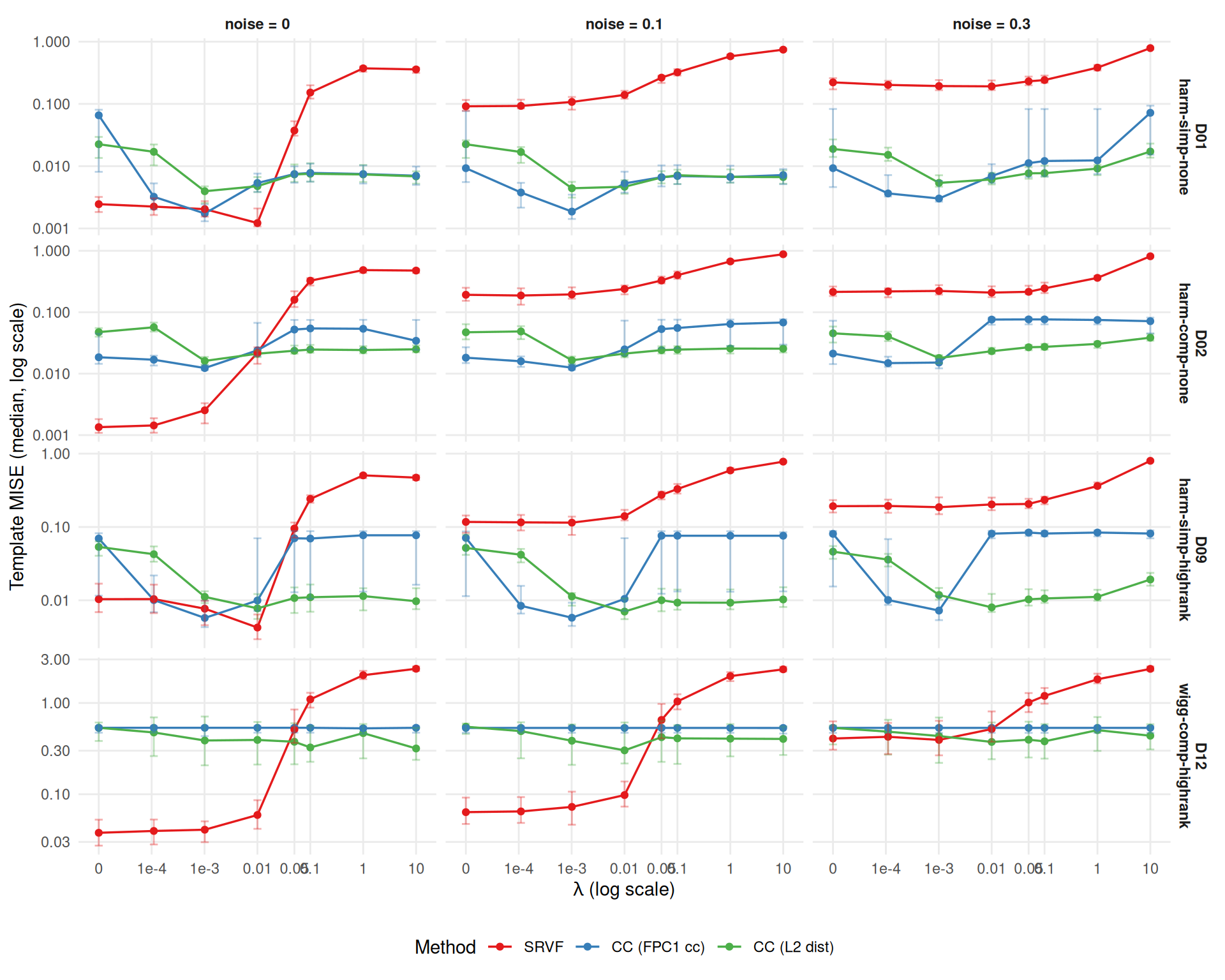
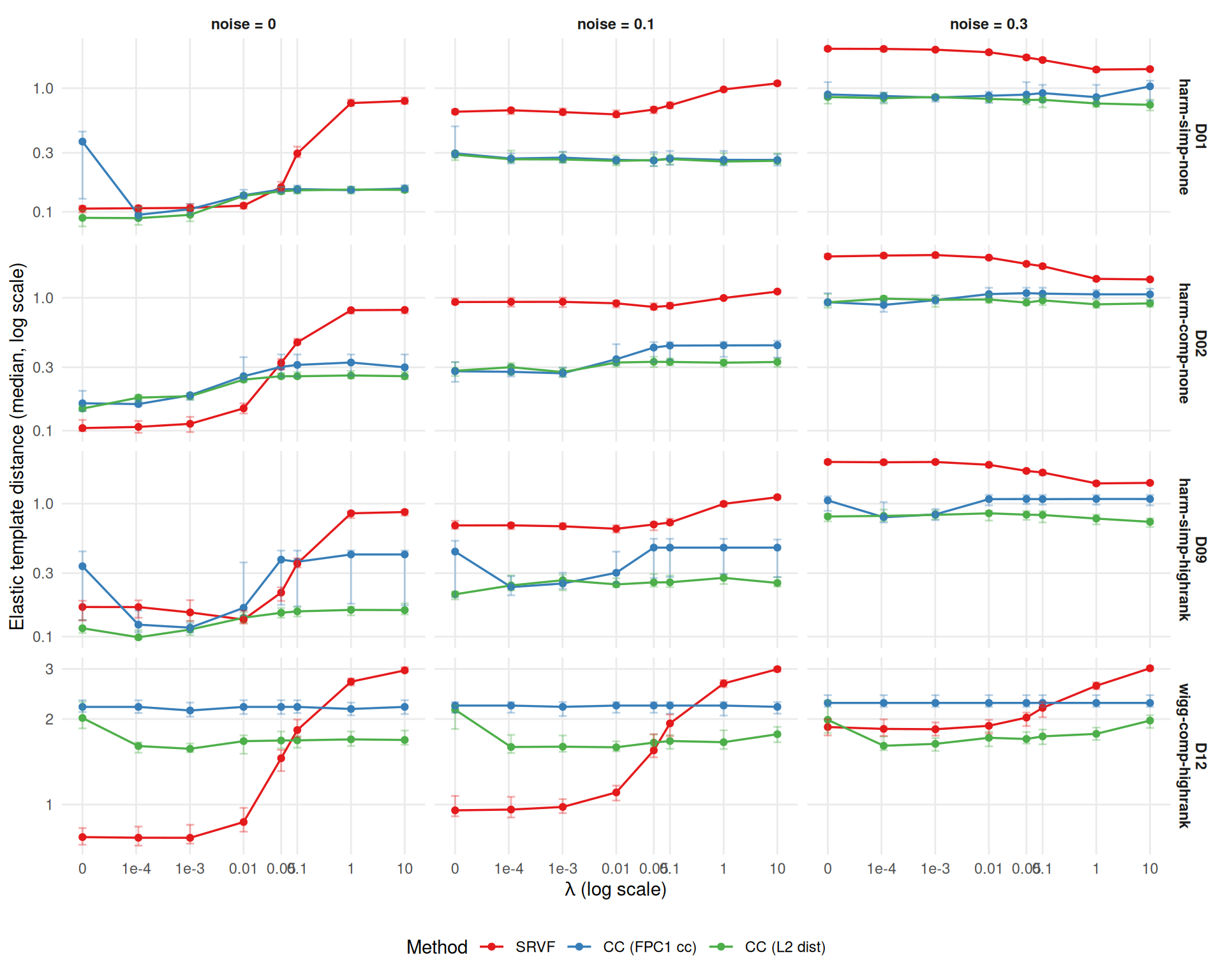
has_elastic_b <- "template_elastic_dist" %in% names(dt) &&
  any(!is.na(dt$template_elastic_dist))

if (has_elastic_b) {
  edist_agg <- aggregate_median_iqr(
    dt = dt[failure == FALSE & severity == "1" &
        !is.na(template_elastic_dist)],
    metric = "template_elastic_dist",
    by = c("method", "dgp", "noise_sd", "lambda"),
    value_name = "edist"
  )

  ggplot(edist_agg,
    aes(x = lambda + 1e-5, y = edist, color = method)) +
    geom_line(linewidth = 0.6) +
    geom_point(size = 1.5) +
    geom_errorbar(aes(ymin = q25, ymax = q75), width = 0.15, alpha = 0.35) +
    facet_grid(dgp ~ noise_sd,
      scales = "free_y",
      labeller = labeller(
        noise_sd = function(x) paste0("noise = ", x),
        dgp = dlabs)) +
    scale_x_log10(
      breaks = c(1e-5, 1e-4, 1e-3, 0.01, 0.05, 0.1, 1, 10),
      labels = c("0", "1e-4", "1e-3", "0.01", "0.05", "0.1", "1", "10")) +
    scale_color_manual(values = mcols, labels = mlabs) +
    scale_y_log10() +
    labs(x = expression(lambda ~ "(log scale)"),
      y = "Elastic template distance (median, log scale)",
      color = "Method") +
    theme_benchmark() +
    theme(legend.position = "bottom")
} else {
  cat("*Elastic template distance not available in Study B results.*")
}
if (has_elastic_b) {
  # Optimize each template metric separately to avoid mixed-target bias
  tmpl_base <- dt[failure == FALSE & lambda == 0 & severity == "1",
    .(tmise_base = median(template_mise, na.rm = TRUE),
      edist_base = median(template_elastic_dist, na.rm = TRUE)),
    by = .(method, dgp, noise_sd)]
  tmpl_by_lambda <- dt[failure == FALSE & severity == "1" &
      !is.na(template_elastic_dist),
    .(tmise = median(template_mise, na.rm = TRUE),
      edist = median(template_elastic_dist, na.rm = TRUE)),
    by = .(method, dgp, noise_sd, lambda)]

  # Best lambda for elastic distance
  best_edist <- tmpl_by_lambda[,
    .SD[which.min(edist)],
    by = .(method, dgp, noise_sd)]
  edist_comp <- merge(best_edist, tmpl_base, by = c("method", "dgp", "noise_sd"))
  edist_comp[, edist_ratio := edist / edist_base]

  # Best lambda for template MISE (optimized independently)
  best_tmise <- tmpl_by_lambda[,
    .SD[which.min(tmise)],
    by = .(method, dgp, noise_sd)]
  tmise_comp <- merge(best_tmise, tmpl_base, by = c("method", "dgp", "noise_sd"))
  tmise_comp[, tmise_ratio := tmise / tmise_base]

  n_edist_helps <- sum(edist_comp$edist_ratio < 0.9)
  n_tmise_helps <- sum(tmise_comp$tmise_ratio < 0.9)
  cat(sprintf(
    "**Template quality under penalization** (each metric optimized at its own best λ): elastic template distance improves >10%% in %d/%d cells; template MISE improves >10%% in %d/%d cells. ",
    n_edist_helps, nrow(edist_comp), n_tmise_helps, nrow(tmise_comp)))

  # Which method benefits most for template shape?
  avg_edist <- edist_comp[, .(mean_ratio = mean(edist_ratio, na.rm = TRUE)),
    by = method]
  best_tmpl_m <- avg_edist[which.min(mean_ratio)]
  edist_method_summary <- mean_se_table(edist_comp, "edist_ratio", "method")
  best_tmpl_summary <- edist_method_summary[method == best_tmpl_m$method]
  cat(sprintf(
    "%s benefits most for template *shape* (mean elastic distance ratio %s).\n\n",
    mlabs[best_tmpl_m$method],
    fmt_mean_se(best_tmpl_summary$mean, best_tmpl_summary$se)
  ))
}
Template quality under penalization (each metric optimized at its own best λ): elastic template distance improves >10% in 15/36 cells; template MISE improves >10% in 24/36 cells. CC (FPC1 cc) benefits most for template shape (mean elastic distance ratio 0.80 ± 0.08).
Alignment error measures how well registered curves match the true pre-warp curves: \(\text{mean}_i \int (\hat{x}_i^{\text{aligned}} - \tilde{x}_i)^2\,dt\). This captures the practical downstream impact of registration quality, complementing the warp MISE.
ae_agg <- dt[failure == FALSE,
  .(ae = median(alignment_error, na.rm = TRUE),
    q25 = quantile(alignment_error, 0.25, na.rm = TRUE),
    q75 = quantile(alignment_error, 0.75, na.rm = TRUE)),
  by = .(method, dgp, noise_sd, severity, lambda)
]

ae_baseline <- ae_agg[lambda == 0, .(method, dgp, noise_sd, severity, base = ae)]

ggplot(ae_agg[severity == "1"],
  aes(x = lambda + 1e-5, y = ae, color = method)) +
  geom_line(linewidth = 0.6) +
  geom_point(size = 1.5) +
  geom_errorbar(aes(ymin = q25, ymax = q75), width = 0.15, alpha = 0.4) +
  geom_hline(data = ae_baseline[severity == "1"],
    aes(yintercept = base, color = method),
    linetype = "dashed", alpha = 0.5) +
  facet_grid(dgp ~ noise_sd,
    scales = "free_y",
    labeller = labeller(
      noise_sd = function(x) paste0("noise = ", x),
      dgp = dlabs)) +
  scale_x_log10(
    breaks = c(1e-5, 1e-4, 1e-3, 0.01, 0.05, 0.1, 1, 10),
    labels = c("0", "1e-4", "1e-3", "0.01", "0.05", "0.1", "1", "10")) +
  scale_color_manual(values = mcols, labels = mlabs) +
  scale_y_log10() +
  labs(x = expression(lambda ~ "(log scale)"),
    y = "Alignment error (median, log scale)",
    color = "Method") +
  theme_benchmark() +
  theme(legend.position = "bottom")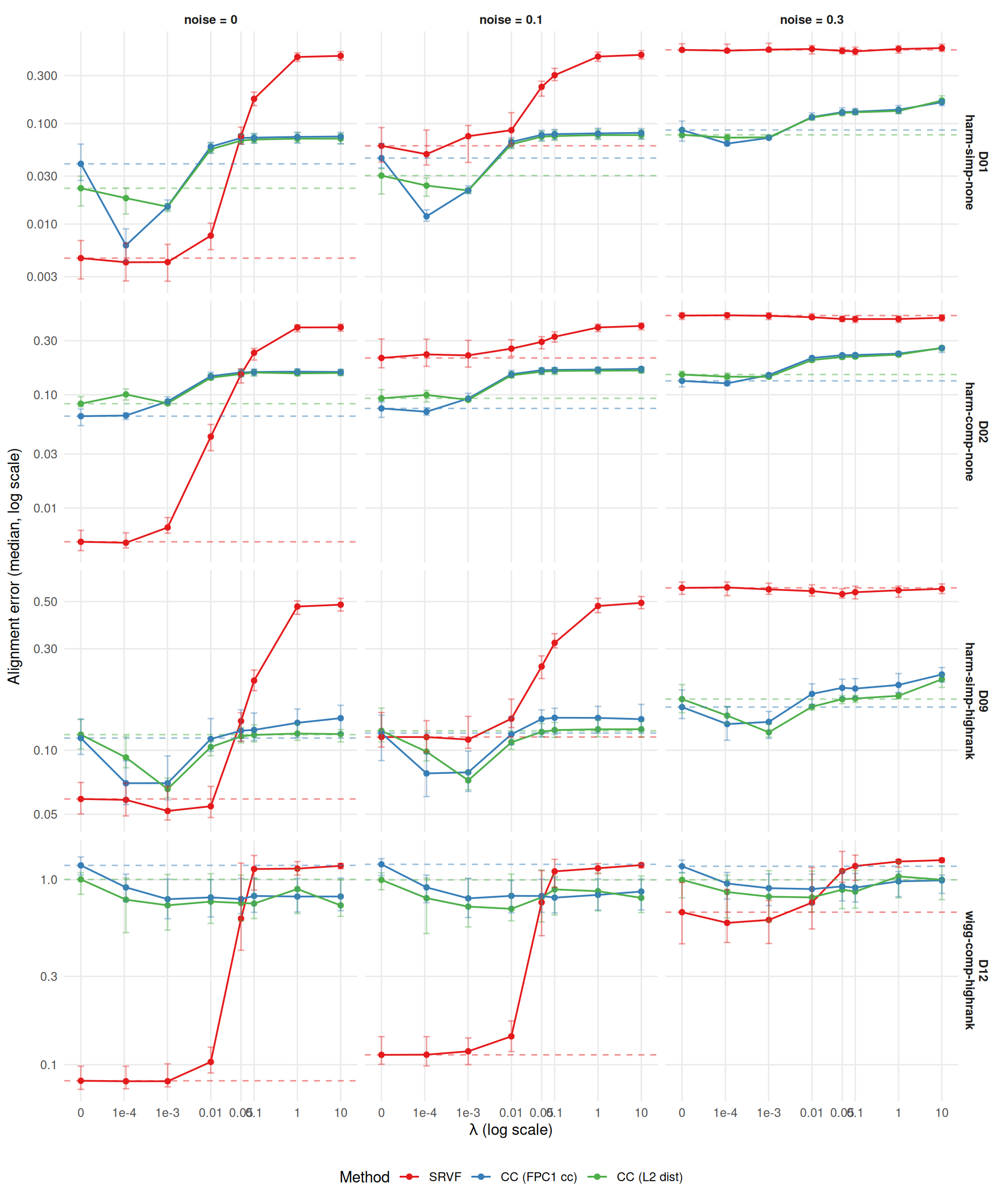
cat("**Alignment error: optimal lambda and improvement**\n\n")Alignment error: optimal lambda and improvement
# How often does lambda > 0 help alignment error?
n_helps_ae <- nrow(ae_merged[ratio < 0.95])
n_total_ae <- nrow(ae_merged)
cat(sprintf("- Lambda > 0 improves alignment error by >5%% in %d/%d (%.0f%%) cells.\n",
n_helps_ae, n_total_ae, 100 * n_helps_ae / n_total_ae))# Does alignment error agree with warp MISE on optimal lambda?
agree <- sum(lambda_comp$agree)
cat(sprintf("- Optimal lambda for alignment error agrees with warp MISE in %d/%d (%.0f%%) cells.\n",
agree, nrow(lambda_comp), 100 * agree / nrow(lambda_comp)))# Correlation between alignment error and warp MISE improvement ratios
warp_merged_sub <- merged[, .(method, dgp, noise_sd, severity, warp_ratio = ratio)]
ae_merged_sub <- ae_merged[, .(method, dgp, noise_sd, severity, ae_ratio = ratio)]
both <- merge(warp_merged_sub, ae_merged_sub,
by = c("method", "dgp", "noise_sd", "severity"))
r_improvement <- cor(both$warp_ratio, both$ae_ratio, use = "complete.obs")
cat(sprintf("- Correlation between warp MISE and alignment error improvement ratios: r = %.2f.\n",
r_improvement))ae_ratio_summary <- mean_se_table(ae_merged, "ratio", "method")[order(mean)]
cat("Average alignment-error improvement ratio across the 24 method-specific cells ",
"(mean ± SE):\n\n")Average alignment-error improvement ratio across the 24 method-specific cells (mean ± SE):
for (i in seq_len(nrow(ae_ratio_summary))) {
  r <- ae_ratio_summary[i]
  cat(sprintf("- **%s**: %s (n=%d)\n",
    mlabs[r$method], fmt_mean_se(r$mean, r$se), r$n))
}cat("\n")# Biggest improvement
biggest_ae <- ae_merged[which.min(ratio)]
cat(sprintf("- Largest alignment error improvement: %s on %s (noise=%s, sev=%s): %.0f%% at λ=%g.\n\n",
mlabs[biggest_ae$method], biggest_ae$dgp, biggest_ae$noise_sd, biggest_ae$severity,
100 * (1 - biggest_ae$ratio), biggest_ae$lambda))if (r_improvement > 0.9) {
cat("The two metrics respond nearly identically to penalization — the same lambdas ",
"that improve warp recovery also improve alignment quality.\n")
} else if (r_improvement > 0.7) {
cat("The metrics are strongly correlated but not identical — in some cells, the ",
"lambda that minimizes warp MISE is not optimal for alignment error.\n")
} else {
cat("The metrics show moderate agreement — penalization affects warp recovery ",
"and alignment quality somewhat differently.\n")
}The metrics are strongly correlated but not identical — in some cells, the lambda that minimizes warp MISE is not optimal for alignment error.
# Summary table: best lambda and improvement per method x DGP
summary_dt <- copy(merged)
summary_dt[, improvement := sprintf("%.0f%%", 100 * (1 - mise / base_mise))]
summary_dt[, cell := sprintf("λ=%g (%s)", lambda, improvement)]

summary_wide <- dcast(
  summary_dt[severity == "1", .(method, dgp, noise_sd, cell)],
  method + dgp ~ noise_sd,
  value.var = "cell"
)

cat("## Optimal lambda and improvement at severity=1.0\n\n")knitr::kable(
summary_wide[order(method, dgp)],
caption = "Optimal lambda and MISE improvement vs lambda=0, by method × DGP × noise (severity=1.0)."
)| method | dgp | 0 | 0.1 | 0.3 |
|---|---|---|---|---|
| srvf | D01 | λ=0.001 (33%) | λ=0.0001 (9%) | λ=0.1 (6%) |
| srvf | D02 | λ=0.0001 (11%) | λ=0.0001 (8%) | λ=0.1 (12%) |
| srvf | D09 | λ=0.001 (20%) | λ=0.0001 (3%) | λ=0.05 (6%) |
| srvf | D12 | λ=0.0001 (1%) | λ=0 (0%) | λ=0 (0%) |
| cc_default | D01 | λ=0.0001 (93%) | λ=0.0001 (93%) | λ=0.0001 (85%) |
| cc_default | D02 | λ=0.0001 (11%) | λ=0.0001 (10%) | λ=0.0001 (3%) |
| cc_default | D09 | λ=0.001 (75%) | λ=0.001 (75%) | λ=0.001 (70%) |
| cc_default | D12 | λ=1 (51%) | λ=10 (52%) | λ=0.01 (49%) |
| cc_crit1 | D01 | λ=0.001 (37%) | λ=0.001 (35%) | λ=0.001 (30%) |
| cc_crit1 | D02 | λ=0.001 (20%) | λ=0.001 (20%) | λ=0.001 (23%) |
| cc_crit1 | D09 | λ=0.001 (71%) | λ=0.001 (71%) | λ=0.001 (68%) |
| cc_crit1 | D12 | λ=1 (52%) | λ=1 (51%) | λ=0.1 (49%) |
cat("## Key takeaways\n\n")cat("*Note: statistics below pool both severities unless stated otherwise.*\n\n")Note: statistics below pool both severities unless stated otherwise.
# Count how often lambda > 0 is optimal
n_helps <- nrow(optimal[lambda > 0])
n_total <- nrow(optimal)
cat(sprintf("- Lambda > 0 is optimal in %d/%d (%.0f%%) of method × DGP × condition cells.\n",
n_helps, n_total, 100 * n_helps / n_total))# Severity breakdown for lambda > 0
for (s in levels(optimal$severity)) {
sub <- optimal[severity == s]
n_h <- nrow(sub[lambda > 0])
n_t <- nrow(sub)
cat(sprintf(" - Severity %s: %d/%d (%.0f%%)\n", s, n_h, n_t, 100 * n_h / n_t))
}# Biggest beneficiary
biggest <- merged[which.min(ratio)]
cat(sprintf("- Largest improvement: %s on %s (noise=%s, sev=%s) — %.0f%% at λ=%g.\n",
mlabs[biggest$method], biggest$dgp, biggest$noise_sd, biggest$severity,
100 * (1 - biggest$ratio), biggest$lambda))# Method that benefits most on average
avg_by_method <- mean_se_table(merged, "ratio", "method")
best_method <- avg_by_method[which.min(mean)]
cat(sprintf("- Method benefiting most from penalization on average: %s (mean ratio %.2f).\n",
mlabs[best_method$method], best_method$mean))# Severity breakdown for mean improvement ratio
cat("- Mean improvement ratio by method and severity:\n")avg_by_method_sev <- mean_se_table(merged, "ratio", c("method", "severity"))
for (i in seq_len(nrow(avg_by_method_sev))) {
r <- avg_by_method_sev[i]
cat(sprintf(" - %s, severity %s: %s\n",
mlabs[r$method], r$severity, fmt_mean_se(r$mean, r$se)))
}cat("\n")