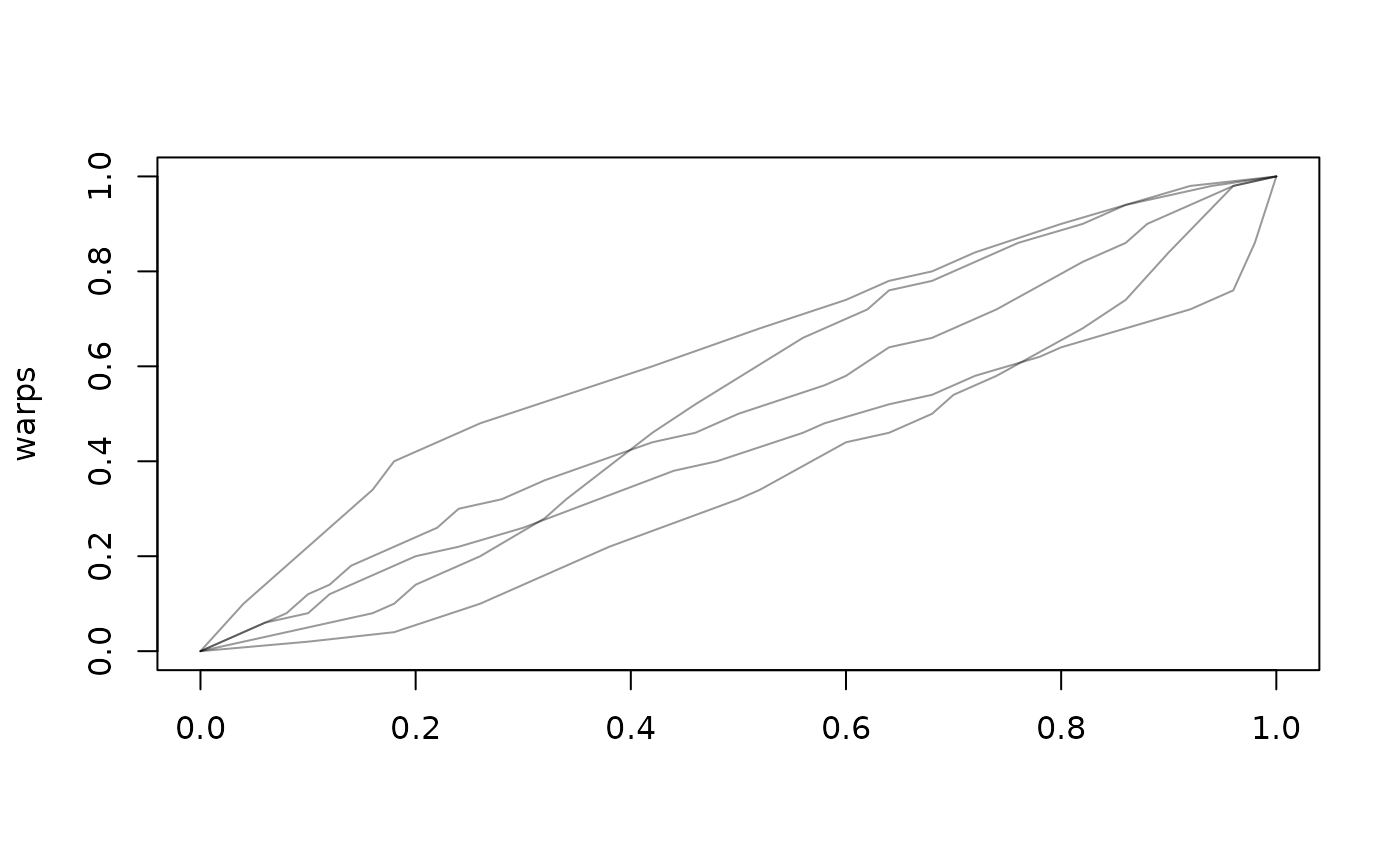
tf_estimate_warps() is the low-level workhorse for functional data
registration. It estimates warping functions that align a set of functions to
a template, but does not apply them. For a one-shot interface that also
aligns the data, see tf_register().
Usage
tf_estimate_warps(
  x,
  ...,
  template = NULL,
  method = c("srvf", "srvf_mv", "cc", "affine", "landmark"),
  max_iter = 3L,
  tol = 0.01
)
Arguments
- x
a
tfvector of functions to register.- ...
additional method-specific arguments passed to backend routines (for example
critformethod = "cc").- template
an optional
tfvector of length 1 to use as the template. IfNULL, a default template is computed (method-dependent). Not used formethod = "landmark".- method
the registration method to use:
"srvf": Square Root Velocity Framework (elastic registration). For details, seefdasrvf::time_warping(). Default template is the Karcher mean."srvf_mv": true multivariate SRVF time registration fortf_mvobjects on a regular shared grid. This method estimates one shared warp from all components jointly and does not rotate or rescale curves."cc": continuous-criterion registration via a tf-native dense-grid optimizer with monotone spline warps. Default template is the arithmetic mean."affine": affine (linear) registration with warps of the form \(h(t) = a \cdot t + b\). Simpler than elastic registration, appropriate when phase variability consists only of shifts and/or uniform speed-up/slow-down. Default template is the arithmetic mean."landmark": piecewise-linear warps that align user-specified landmark features. Requireslandmarksargument.
- max_iter
integer: maximum number of Procrustes-style template refinement iterations when
template = NULL. The iteration cycle is: (1) estimate template as mean of (aligned) curves, (2) register all curves to current template, (3) update template as mean of newly aligned curves, (4) repeat until convergence ormax_iterreached. Ignored whentemplateis provided (no refinement needed) or formethod = "landmark"(template not used). Formethod = "srvf"withtemplate = NULL, the outer Procrustes loop is skipped regardless ofmax_iterbecausefdasrvf::time_warping()already computes the Karcher mean internally. Default is3L.- tol
numeric: convergence tolerance for template refinement. For
method = "cc", iteration stops when the relative improvement in the registration criterion becomes negligible; for the other iterative methods, iteration stops when the relative change in the template (L2 norm) falls belowtol. Default is1e-2.
Value
tfd vector of (forward) warping functions \(h_i(s) = t\)
with the same length as x.
Apply with tf_align() to obtain registered functions, or use
tf_invert() to obtain inverse warps \(h_i^{-1}(t) = s\).
The returned warps carry an attr(, "template") with the template used
(NULL for landmark registration, which has no template).
Details
For method = "cc", tf uses a tf-native dense-grid optimizer with
monotone spline warps. Each warp is represented as the normalized cumulative
integral of exp(eta(t)), where eta(t) is a spline with nbasis
coefficients. Registration is then carried out curve-by-curve by minimizing
either an integrated squared-error criterion (crit = 1) or the
first-eigenfunction variance criterion (crit = 2) plus an optional spline
roughness penalty (lambda). The outer max_iter loop, when template = NULL, still performs the same Procrustes-style template refinement as the
other methods.
Important method-specific arguments (passed via ...)
For method = "srvf":
lambdanon-negative number: penalty controlling the flexibility of warpings (default is
0for unrestricted warps).penalty_methodcost function used to penalize warping functions. Defaults to
"roughness"(norm of their second derivative),"geodesic"uses the geodesic distance to the identity and"norm"uses Euclidean distance to the identity.
For method = "cc":
nbasisinteger: number of B-spline basis functions for the monotone warp basis (default
6L, minimum 2).lambdanon-negative number: roughness penalty for the warp basis (default
0for unpenalized warping).critregistration criterion. Defaults to
2for the first-eigenfunction variance criterion; alternative is1for integrated squared error.convnon-negative convergence tolerance for the inner optimizer. Default is
1e-4.iterlimmaximum number of inner optimization iterations per curve. Default is
20L.
For method = "affine":
typecharacter:
"shift"(translation only),"scale"(scaling only), or"shift_scale"(both). Default is"shift".shift_rangenumeric(2): bounds for shift parameter. Default is
c(-range/2, range/2)where range is the domain width. Larger bounds allow greater shifts but may result in moreNAvalues.scale_rangenumeric(2): bounds for scale parameter. Default is
c(0.5, 2). Must havelower > 0.
For method = "landmark":
landmarks(required) numeric matrix of landmark positions with one row per function and one column per landmark. Use
tf_landmarks_extrema()to find peaks/valleys automatically.template_landmarksnumeric vector of target landmark positions. Default is column-wise mean of
landmarks.
See also
Other registration functions:
tf_align(),
tf_landmarks_extrema(),
tf_register(),
tf_register_shape(),
tf_registration,
tf_warp()